
Around 99% of light and heavy trucks operating across MENA run with no real telematics on board. The majority of trucks will have a GPS box with geofencing and an embedded over-speeding alert; two readings that have become “table stakes” in modern fleets since the early 2000s. These readings answer where the truck is and whether the driver crossed a line on a map, while the engine underneath is largely silent to the fleet owner.
The numbers inside the truck
A 2008 Mercedes-Benz Actros carries around 30 Electronic Control Units (ECUs). A 2017 Actros carries 40 to 60, depending on spec. Both figures come from AutoPulse connected vehicle data.
Each ECU individually publishes between 10 and 150 live readings, which puts the older truck somewhere between several hundred and 1,000+ live readings at any given moment. A working truck generates up to 25 GB of live stream data every hour.
An ECU is a small dedicated computer inside the truck. Every “department” inside the vehicle has one. For instance, there is an engine ECU, a gearbox ECU, a braking system ECU, and a chassis ECU—all in one car or truck. Each measures its own conditions and broadcasts them onto the main vehicle ECU, continuously, whether or not anyone is listening.
| Reading | System | Sample value |
|---|---|---|
| Engine speed | Engine | 1,450 rpm |
| Engine coolant temperature | Engine | 88 °C |
| Engine oil temperature | Engine | 96 °C |
| Engine oil pressure | Engine | 3.8 bar |
| Calculated engine load | Engine | 62% |
| Intake manifold pressure | Engine | 185 kPa |
| Intake air temperature | Engine | 42 °C |
| Fuel rail pressure | Engine | 1,250 bar |
| Fuel consumption rate | Engine | 24 L/h |
| Engine operating time | Engine | 12,840 h |
| Active fault codes | Diagnostics | 0 codes |
| Vehicle speed | Drivetrain | 72 km/h |
| Selected gear | Transmission | 10 |
| Transmission oil temperature | Transmission | 78 °C |
| Battery voltage | Electrical | 27.6 V |
| Fuel tank level | Fuel system | 64% |
| Brake air pressure | Brakes | 9.2 bar |
| Brake pedal position | Brakes | 0% |
| Ambient air temperature | Environment | 34 °C |
| Odometer | Vehicle | 486,210 km |
What zero telematics actually costs
Ask any fleet operator in the region about their worst engine bill, and often the story starts the same way, with a truck that was in action. Coolant temperature climbs on a long haul and the driver keeps going because the load has to arrive and nothing on the dashboard makes stopping feel urgent. A check engine light comes on and stays on for three weeks while the truck keeps running its route, since the light says something is wrong without saying what or how bad. By the time oil pressure or an injector problem shows up as a noise the driver can hear, the damage is already priced into the next overhaul, and the workshop is the first party to see the actual condition of the engine.
The cost of that is measurable. Running an engine through repeated overheating events instead of stopping at the first alert takes 20 to 30% off its service life, and a single sustained overheat can blow a gasket in one trip. Fleets that fix on failure rather than on condition pay roughly 2 to 3 times the cost of the same repair caught early, and fleets that move to condition-based maintenance typically cut maintenance spend by 10 to 15% and unplanned breakdowns by around 25%.
MENA climate and road conditions accelerate all of this. AutoPulse data shows service intervals in Egypt running 40 to 70% shorter than the same truck in a market with mild conditions, driven by fuel sulfur content, ambient heat, dust load and stop-and-go duty cycles. A fleet service schedule calibrated to a European book is late on almost every interval and pays for it at overhaul.
How AutoPulse solves this
AutoPulse connects an OBD sensor directly to the truck and pulls live telematics at intervals as tight as 200 milliseconds, which is fast enough to catch transient events that slower polling misses entirely. Coolant spikes, cranking voltage dips, misfire counters, fault codes and load history all land in one place as they happen.
Fleet managers get one big beautiful control tower: every car and truck in the fleet on one screen, with the live readings coming off each vehicle, alerts when a unit moves out of range, and a maintenance picture based on how the asset was actually driven. We run this today with clients across F&B, bottling, oil and gas, trucking and logistics.
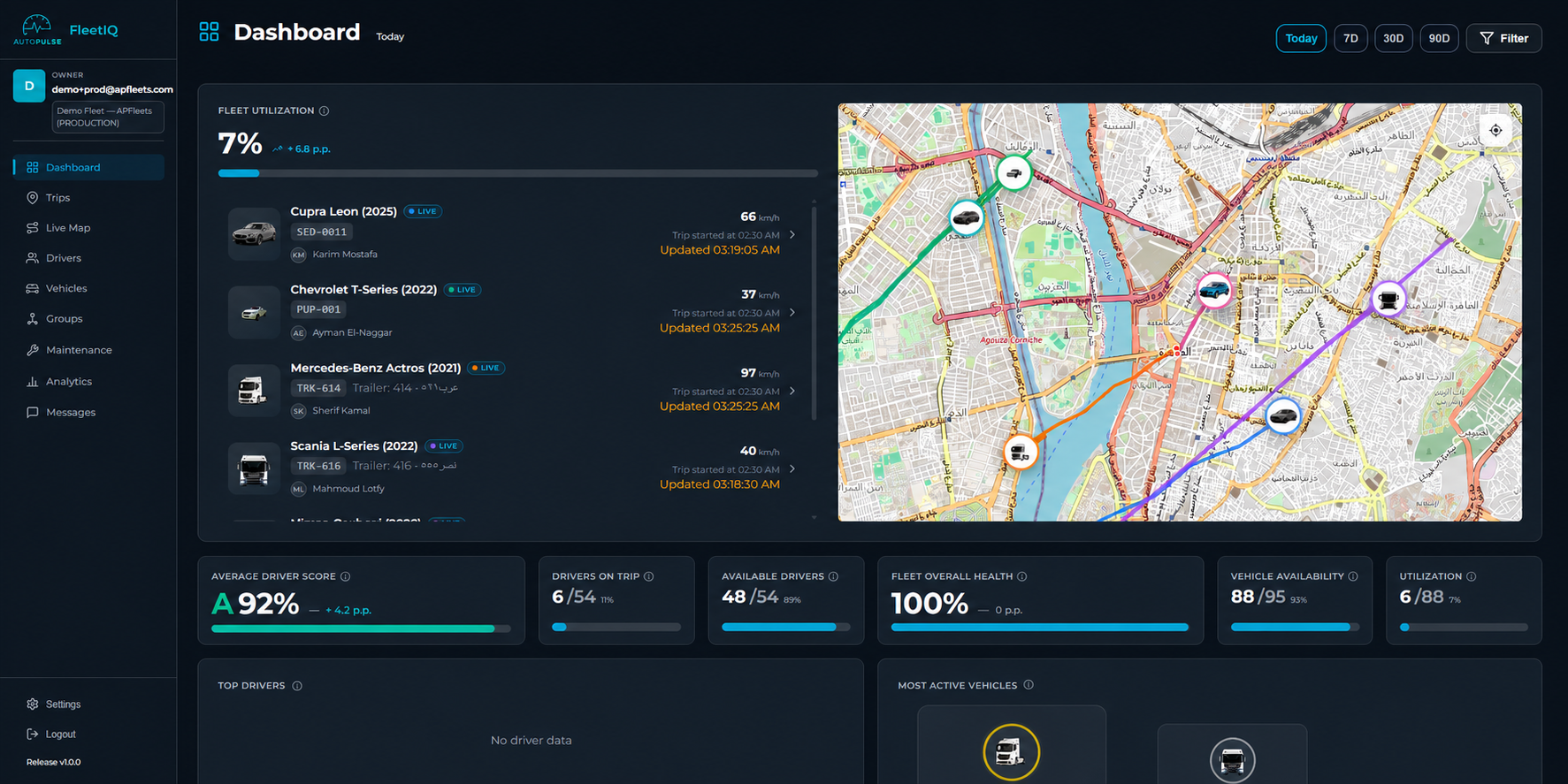
If you operate a fleet in MENA and your dashboard shows dots on a map, there are thousands of readings per vehicle per hour you are already paying to generate and not using.